8/01/2011

VOICE OF GLOBAL UMMAH
Volume 194, July 31, 2011
Thiruvananthapuram, Kerala, India

Editors: Mohamed & Rashida Ziauddin

In the Name of Allah, the Most Beneficent and the Most Merciful


EDITORIAL:

We ended our overseas trip with our last stop at Thiruvananthapuram (Trivandrum) which is the capital of the State of Kerala. This is the third and last exclusive part of the DIVERSITY OF UMMAH series. Historically Kerala was the gateway for Islam to enter India. Not surprisingly Kerala has some of the oldest mosques in India including one called Valiyapalli at Jonakappuram which is 1400 years old.

Those who believe that ISLAM SPREAD EXCLUSIVELY BY THE SWORD should enlighten themselves by understanding the history of Muslims in Kerala, Tamil Nadu et.c and realize that businessmen and traders cannot start their business in a new country WITH A SWORD. Almost all natives of India in the South converted to Islam voluntarily.


We highlighted a large part of this E-Zine on Mosques in Kerala given their historical and architectural uniqueness besides emphasizing on the history of Islam and Muslims in Kerala. Nearly quarter of the population of Kerala are Muslims reflecting a much higher percentage of Muslims compared to national average.


India's Biggest Mosque to Come up at Kozhikode,
KERALA

www.ssfmalappuram.com


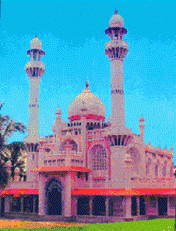
India's biggest mosque, capable of accommodating 25,000 people at a time, will come up on a 12 acre site at the sprawling 'Knowledge City' complex of an Islamic Centre of learning near here.

Estimated to cost Rs 40 crore, it will be one of India's important Islamic cultural centres, sources at the Jamia Markazu Ssaquafathi Ssunniyya, an education and cultural organisation, said.

Work would begin within five months and be completed in less than two years, they said. Thrissur-based architect Riyaz Muhammad, designer of the mosque, said it would be based on the Mughal architectural style. "It will strictly follow the green building concept so that the built-up area harmoniously blends with the greenery around", he told PTI.

The building would cover eight acres and be surrounded by a four acre green belt and beautiful garden. Besides a vast prayer hall, the complex would have an auditorium for seminars, a huge library and facilities to accommodate over 1000 people at a time, he said.

Located at Karanthur about 10 km from Kozhikode, Markazu is an Islamic centre of learning and charity, headed by religious scholar Kanthapuram A P Aboobker Musliyar.


THIRUVANANTHAPURAM, KERALA

The word Thiru Ananthapuri, means the City of Anantha or the abode of the sacred thousand-headed serpent Anantha, who forms the couch on which reclines Lord Vishnu, the preserver in the Trinity of Hindu gods.


MUSLIM CHILDREN IN KERALA


Panoor Muslim Jama-Ath Murukkumpuzha Muslims of Kerala
Quran study class every Friday 07.30pm-8.30pm


(Tourist resort in Kerala)


Muslim woman practicing Kalari one of the oldest fighting systems in existence (www.defense.pk)


Practicing Kalaripayattu in Kerala

Indian Martial Arts-- Kalaripayattu.
(www.defence.pk)

Kalaripayattu - The Orient's treasure trove, a gift to the modern world and the mother of all martial arts. Legend traces the 3000-year-old art form to Sage Parasurama- the master of all martial art forms and credited to be the re-claimer of Kerala from the Arabian Sea. Kalaripayattu originated in ancient South India.

Kung- fu, popularized by the monks of the Shoaling Temple traces its ancestry to Bodhi Dharma - an Indian Buddhist monk and Kalaripayattu master.


Crafted in ancient South India drawing inspiration from the raw power and sinuous strength of the majestic animal forms - Lion, Tiger, Elephant, Wild Boar, Snake, and Crocodile ........ Kalaripayattu laid down the combat code of the Cholas, the Cheras and the Pandyas. Shrouded in deep mystery and mists of secrecy Kalaripayattu was taught by the masters in total isolation, away from prying eyes.


(Sunset in Kerala)


(Scenic view in Kerala)


(Boathouse in Kerala)


HISTORY OF ISLAM IN KERALA- PART I

Islam is believed entered into India through Kerala. There are historical records of commercial trading between Kerala and Middle East during 7th Century AD. The Jews and Arabs of the pre-Islamic period were among the pioneers of spice trade with Kerala. The religion of Islam was also by these traders from Middle East, who later settled in Coastal belt of Kerala. To this day Muslims are very proficient in trade and commerce. Muslims in Kerala, as anywhere else in the world, are close-knit unit clear-cut religious and political agenda.

Historians says that Muslim history in Kerala go back to 7th century AD when the religion originated in Arabia. The numbers increased in the 9th century. In the 8th century there were many centers for religious conversion in the state. Pallibana Perumal’s (He was one of the prominent king of Cheraman Perumal dynasty who embraced Islam ) pilgrimage to Mecca was a major influence in this regard.

It is believed that Malik Ibn Dinar, a disciple of Prophet Mohammed was the first person who propagated Islam in Kerala. The history of Muslims in Kerala is closely intertwined with the history of Muslims in nearby Laccadives islands.

Mappila Rebellion of 1921 was a great chapter of India's freedom struggle. It was the expression of the built up frustration and rage amongst Muslims against British Government and landlords. Variyankode Kunhahammad Haji, Ali Musliar and Veliyankod Umar Khazi were the prominent Muslim leaders who lead this rebellion. The British tried to split the Hindus and Muslims as part of their 'divide and rule' strategy. Many Muslims were hanged or deported. The British were eventually forced to abandon their scheme to deport large numbers of Muslims to Andamans.

Relief organizations came to the aid of widows and orphans. One of the orphanages established of this purpose still exists on Maryhill in Calicut. None of the community in Kerala lost wealth and people compared to Muslims of Kerala, especially from Malabar.

Social, educational and service organizations evolved around Muslim religious institutions. Ponnani was a major center of higher learning. Students from foreign lands came to study there. There were institutes attached to mosques in Ponnani, Thanoor, Thirurangadi, Parappanangadi, Nadapuram, Kodiyathur, Mahi, Vadakara and Payannur some 700 years ago.

From the end of the 19th century to the first three decades of this century those who led the community include Hamadini Sheik, Vakkam Abdul Kadar Maulavi, and K.M. Seethi Sahib. A number of social and political organizations have formed to enhance English and modern education among Muslims.Vakkam Abdul Kadar Moulavi was a leader who made significant contributions in the social arena from 1873 to 1933. He was the founder of the famous newspaper 'Swadeshabhimani' and two other newspapers.

Muslim League the first true political organization came in to being in 1937.Leaders like K. M. Seethi Sahib joined the Muslim League from Congress.In the first elections in Travancore Muslim League and Congress ran under an alliance. Mr. T. A. Abdulla became a minister. In Cochin state Mr. Seethi Sahib was elected unopposed to the state assembly. Both he and Mr. V. K. Kutty Sahib fought for the rights of Muslims in the state.

Arabic language played a dominant role in the culture of Kerala Muslims. There were several Kerala writers of worldwide renown in Arabic.

Several Kerala Muslim writers have made their impact on Malayalam literature. These works include novels, short stories, poetry, history, and travelogues. Among Kerala Muslim writers one name that stands out is that of late Vaikkam Muhammed Basheer.


Islam in Kerala- Part II
(www.prokerala.com)

Kerala had trade relations with many foreign countries, especially those in the middle-east like Assyria and Babylonia, right from the ancient period. Kerala was frequently visited by Arab traders for its spices, Teakwood, Ivory etc... Islam was propagated in Kerala by these traders and it is believed that the religion spread to other parts of India from Kerala. Many of these traders later settled in the coastal areas of Kerala. In 644 A.D., Malikben Dinar reached Kerala, propagated the religion and established mosques at various places.

Today, Muslims form the second largest religious community in Kerala constituting 24.7% of the total population. Majority of the Muslim population is in the northern districts of the state. Malappuram has the largest Muslim population followed by Kannur, Kozhikode and Wayanad.


UNIQUE MARRIAGE CUSTOMS OF MUSLIMS IN KERALA

Oppana Muslim Dance


(indianholiday.com)

"Oppana is a dance form and a performing art practiced by the Muslim women in the Malabar region of Kerala, especially the districts of Canaonore, Calicut and Malappuram.

It is believed that the word Oppana derives its origin from the word Afna (Arabic).


It is performed to commemorate the nuptial celebrations of the bride and is part of the wedding festivities. It is a famed form of social entertainment. Maidens and the female relatives of the bride sing and dance clapping their hands.

The bride is decked in finery and intricate ornaments and seated in the middle on a high seat called the peetam. The bride’s friends and other young ladies clap their hands rhythmically to the beat of the song and dance around her. There are about 15 performers including the musicians. The dance is not vigorous and the steps are simple and movements graceful. Sometimes a type of Oppana called Oppana Chayal is performed that does not involve the clapping of hands. The other type of Oppana is Oppana Murukkam.

The songs sung are called Mappilapattu and are sung firstly by the leader and the remaining women lend the chorus. Two or three girls lead the dance and the rest soon join in. The songs’ themes are usually teasing comments and insinuations to the marital bliss and the shy bride’s emotions. The language is a combination of Arabic & Malayalam.

In some households the men also perform the Oppana for the groom’s entertainment. In these cases it is performed before leaving for the bride’s place. It is there that the wedding (Nikkah) is performed. In some cases the men also perform the Oppana as the groom enters the Maniyara (Bridal Chamber). The instruments played along are the Harmonium, Ganjira, Tabla and Elathaalam.
(Source: www.mapsofindia.com)


MUSLIM WEDDING IN KERALA
(www.zawaj.com)

zawaj.com

The father of the bride performing Kanya-dhan (promising his daughter's hand) to the bridegroom at a Muslim wedding in Trivandrum, Kerala state, India

Indian Muslims follow the same pattern in Nikah as followed by the Middle-Eastern Muslims. Before the wedding there are some ceremonies in both the girl's and the groom's house, which is full of singing and dancing, strictly according to the rules laid down in Islam. A henna ceremony is held in the bride's house. There is no rule which says that the groom has to stay in the brides house after the Nikah.

After the wedding there is a big reception, given by the bride's parents to guests from both sides, i.e.the groom's side as well as the bride's side. After the reception the groom's party returns with the bride to the groom's house, if the groom is from the same city. But if the groom is from another city it depends on the timing of the train or plane which the groom's party will use for the return journey. Or if they have come in their cars it will depend on the groom's family's convenience. The family of the groom also throws a reception to welcome and honour the new bride. This reception is known as dawat-e-walima. This walima occurs one or two days after the wedding. Indian Muslim brides receive gifts form the groom's family known as burri (gold jewels, expensive clothes, money etc.).

Muslim weddings in India are celebrated in a grand way, a tradition which has come down from the Mughul rulers and Sultans of medieval India.
(Deeba Abdin)


THE JUMA MASJID


(keralapilgrimcenters.com)

The Juma Masjid, Palayam Mosque (Palayam Pally Trivandrum) The Masjid-i Jahān-Numā (Arabic: مسجد جھان نما‎, the 'World-reflecting Mosque'), commonly known as the Palayam Pally of Trivandrum, is the principal mosque of Trivandrum in Kerala, India. It is a Juma Masjid (Friday Mosque). The Juma Masjid, Palayam Mosque is the most important mosque in Thiruvananthapuram, India. Situated at Palayam, the mosque has a temple and a Christian church as its neighbours, establishing the communal harmony of Keralites.
(Rajesh Kumar, Indiradevi, Rajagopal)


Mishkal Mosque
(www.globaltourister.com)
Kozhikode
Kerala

(www.rocksea.org)


An architectural and historical landmark, the mosque was constructed by the Arab businessman and ship-owner, Nakhooda Mishkal, nearly 700 years ago. Built extensively out of wood, it is supported on 24 carved pillars and sports 47 doors. The intricate carvings on the ceilings and doors, gopuram style entrance arches, and the absence of minarets is reminiscent of Kerala's temple architecture. (www.globaltourister.com)


Muchundi Mosque (Muchundipalli)
(one of the oldest mosques in Kerala)


(www.en.encylopedia.com)

Muchundi Mosque is a mosque located in Kozhikode (also known as Calicut) in the Indian state of Kerala. It is one of the oldest mosques in Kerala, with a unique temple architecture.It is about 800 years old and it is famous because of Shaikh Zainuddin Makhdoom II, the author of famous book Tuhafat Ul Mujahideen. It was in this mosque where he had his dars, teaching students and probably this is where he wrote his famous book which chronicles the history of Islam in Malabar.

This Masjid is that it had a bilingual stone inscription dating back to the 13th century. It is written in Arabic and an older form of Malayalam. Scholars have translated it to read that one Shihabuddin Raihan, a freed slave built this mosque out of his own money on the land donated by the local ruler.

Karbala Palli Kollam Mosques
Karbala Palli

Serving as the Eid gah for the city’s Muslims, the Karbala Maidan and the adjacent Makani mosque holds importance in the history of Kollam. It has been known as Karbala, ever since a Muslim Jamindar, the leader of 80 other Muslims in the army, was sent to the gallows after a rebellion alleging religious persecution in the British army. His martyrdom was compared to that of Imam Hussain at Karbala in Iraq. The soldier’s mosque known as Pattala Palli in Malayalam jargon was built in 1898 for the Muslim soldiers stationed in the city.


HAZRATH KADUVAYIL THANGAL DARGAH SHAREEF
THIRUVANANTHAPURAM, KERALA


HAZRATH KADUVAYIL THANGAL DARGAH SHAREEF, THIRUVANANTHAPURAM

HAZRATH KADUVAYIL THANGAL DARGAH is another place of pilgrimage that houses the shrine of a famous local Muslim saint. It is on National Highway 47 and attracts people from all religions, who seek the saint's blessings. The centre of attraction is the holy shrine (Darga) of the renowned Sufi Saint known as Kaduvail Thangal, one of the descendants of Prophet Muhamad (PBH).


Mithqalpalli Mosque - Kozhikode
Kerala


(www.keralapilgrimcenters.com)


Jama Palli, a 14th-century Mosque at Kozhikode

(www.keralapilgrimcenters.com)


The spread of Islam in Kerala was mainly through the Arab traders who reached the Malabar coast. From the 7th century onwards the religion attained deep roots in the cultural history of the state. Many mosques of the northern parts of Kerala are centuries old.

The famous Jama palli in Kozhikode dates back to the 14th century. This single storied Muslim shrine can accommodate around 1000 worshipers at a time and has the largest floor area among the mosques of Kerala.

The intricate wood carvings on the ceilings inside the mosque resemble the ancient temple architectural style of Kerala. The wooden walls and ceilings of the inside of the mosque are carved with verses from sacred Arabic texts.

Situated at Kuttichira, the Kozhikode Jum-a Masjid (Jama Palli, as it is called locally) is neighboured by the Mishkal mosque and Muchundipalli, two other ancient mosques of the district.


Jonakappuram Valiyapalli Muslim Palli


The 1400 year old Valiyapalli at Jonakappuram is believed to be the second mosque erected on Indian soil by Malik Ibn Dinar, after the famous Cheraman Juma Masjid in Kodungalloor. As the mosque was destroyed by sea erosion, it has been rebuilt several times and the present structure is said to be constructed on the remnants of the ancient mosque. The Jonakappuram Valiya Palli is believed to have been reconstructed on the remnants of the ancient mosque built by Malik ibn Dinar 1400 years ago. After the Cheraman Juma Masjid in Kodungalloor , this is second mosque erected on Indian soil. But the original mosque got destroyed in the fury of the sea. The mosque was later rebuilt many times.


Ponnani Juma Masjid & Dargh Shareef of Yemeni Sufi Saint


www.ponnani-public.blogspot.com

A 600 years old Mosque was designed by a Hindu Carpenter for a sufi saint who came from Yemen. After the unfortunate fall from top of the mosque while completing the construction, the carpenter was buried inside the mosque. Its believed that only one large teak wood was used for the construction of whole building. In all entrances to the mosque one can read Quranic inscriptions engraved on it.


VALIYA JUMA MASJID

VALIYA JUMA MASJID, MALAPPURAM.
DARGAH OF MALAPPURAM SHAHEEDS( MARTYRS)

This is an important pilgrim centre of the Muslims of Kerala.. Adjoining the mosque is the mausoleum of the Malappuram shaheeds (martyrs) whose brave exploits have been immortalised in the Mappila ballads. URS-E-SHAREEF : The four day annual festival ( Urs-e-Shareef ) at the dargah shareef and mosque (nercha) is celebrated in the month of April every year.


Sayyid Alavi Thangal Mouladdavila Mampuram

Sayyid Alavi Thangal Mouladdavila Mampuram

Very Famous Mosque located at Tirurangadi in Malappuram District of Kerala. Related historically to the 'Mappila Lahala' of 1921 against the then British Government.

The shrine and mausoleum of Qutubu Zaman Sayed Alavi Thangal (Thangals : the religious leaders of the Malabar Muslims)

The famous Mosque and dargah shareef in Mamburam, is a major pilgrimage centre and has the mausoleum of famous Thangals (respected members of the Muslim community. Muslim shrine and receptacle for Mazars of the Thangals (the pious religious leaders of the Malabar Muslims), situated in A.R.Nagar village is a major pilgrimage centre of Muslims.


HISTORY OF MUSLIMS IN KERALA - PART III
www.anantapuri.com
(Dr. P.K.John)

Kerala had connections with Arabia from the time of Solomon. Arabs traded with Kerala for gold, ivory, monkeys and peacocks. Arab merchants came to Kerala from Egypt long before the Romans. Their main port was Alexandria and ours Kodungallore. Pre Khuran references to black pepper, swords from India and teak in Arab poetry indicate trade connection to Kerala. It took about 30 to 40 days for Arabs to make the journey to Kerala.

Muslims of Kerala have always believed that their origins in Kerala go back to 7th century AD when the religion originated in Arabia.

The numbers increased in the 9th century. In the 8th century there were many centers for religious conversion in the state. Cheraman Perumal's pilgrimage to Mecca was a major influence in this regard. The history of Muslims in Kerala is closely intertwined with the history of Muslims in nearby Laccadives islands.

Kerala's only Muslim kingdom was Kannanore's Arakkal family.

Historians disagree as to the time period of Arakkal rulers. Some claim that ancient coins date the Arakkal rulers to the 8th century. Kerala historian Mr. A. Sridhara Menon seem to believe that the Arakkal kings came to power in 16th or 17th century and issued their coins at the earliest in the 18th century. One of the rulers that presided over the kingdom was Junumma Beevi who ruled for 49 years. By 1909 Arakkal rulers lost Cannanore and cantonment. By 1911 there was further decline with loss of "chenkol and udaval".

During those years they allied and clashed with the Portuguese, the Dutch, the French and the English.


The British played the biggest part in removing all vestiges of titles and power from the Arakkal rulers. One of the last kings
Arakkal Abdu Rahiman Ali Raja (1881 -1946) was active in helping his subjects. The last ruler was Ali Raja Mariumma Beevi Thangal. After her time the family broke up.

During the time of the Samuthiries the Muslims of Malabar played major role in the local army and navy as well as ambassadors to Arabia and China. They also forged alliances with Moslil rulers of Gujarat and Bijappur. Even before this period they had settlements in Perumathura, Thakkala, Thengapattanam, Poovar and Thiruvankottu in southern Travancore.

Muslims from Pandi Desham migrated meantime for trade to Erattupetta, Kanjirappalli, Mundakayam, Peruvanthanam and Vandiperiyar in Kottayam district. In the 17th century trade links were established with places like Kayamkulam and Aleppy in the west.
It was during the time of Samuthiris that the title of 'Marakkar' was created.

During the reign of the four Marakkars played significant role in trade. During the time the second Marakkar Muslims spread from port areas to hiiilsides of Valapattanam, Theekkodi, Pandalayani, Kakkadu, Kozocodu, Ponnani. From there many migrated to Palakkadu. Muslim influence reached it's peak at the time of Kunjali Marakkar (4th). After Kunjali Marakkar and Samuthiri parted company Muslim influence declined.


During the Dutch period a prominent Muslim trader named Mooskoi spearheaded the development of trade centers in Chenganacherri, Pandalam, Kayamkulam, and Alappuza. During the time of Hyder Ali and Tippu Sultan there was a revival amongst Muslims of Malabar. The Arakkal king signed a treaty with Hyder Ali. Samathuri followed up with his own treaty with Hyder Ali. In the post Tippu era king Pazassi waged war against the British with the help of Malabar Muslims. In the 19th century anti-british riots erupted on account of their repressive policies.

The British passed a very repressive act in 1852.

19th century saw political servitude and financial ruin. The 1832 earth quake in Malabar and subsequent famine led to mass migration of Muslims to Cochin and Travancore. A prominent leader at the end of 19th century was Veliyankottu Ummarkhasi. From the end of the 19th century to the first three decades of this century those who led the community include Hamadini Sheik, Vakkam Abdul Kadar Mawlawi, and Seethi Sahib.

The so called "MAPPILA LAHALA'' was actually a chapter of India's freedom struggle. It was the expression of the built up frustration and rage amongst Muslims against British Government and land lords. Many prominent Muslims played leadership roles in the "Khilaphath movement' and Indian National Congress.

The British tried to split the Hindus and Muslims as part of their 'divide and rule' strategy. Many Muslims were hanged or deported.


The British were eventually forced to abandon their scheme to deport large numbers of Muslims to Andamans. Relief organizations came to the aid of widows and orphans. One of the orphanages established then still exists on Maryhill in Calicut.

Social, educational and service organizations evolved around religious institutions. Ponnani was a major center of higher learning. Students from foreign lands came to study there. There were institutes attached to Mosques in Ponnani, Thanoor, Thirurangadi, Parappanangadi, Nadapuram, Kodiyathur, Mahi, Vadakara and Payannur some 700 years ago.

In the nineteen hundreds a number of social and political organizations evolved. Muslims who were used to only Arabic education began to give greater emphasis to English education. The government encouraged private Muslim educational institutions and educators. Vakkam Abdul Kadar Moulavi was a leader who made significant contributions in the social arena from 1873 to 1933. He was the founder of the famous newspaper 'Swadeshabhimani' and two other newspapers. He was the greatest leader in modern education among Muslims. Several high schools and elementary schools were started by the Muslim community during this period. Attaining school in Malappuram and a Mohamadan high school in Aleppy came in to existence along with other educational institutions in Edava, Kozikode, Mahi, Ernakulam, Vettathu, and Puthiyangadi.

Muslim League the first true political organization came into being in 1937. Leaders like K. M. Seethi Sahib joined the Muslim League from Congress. In 1924 'Al Amin' newspaper was started to promote social well being and nationalism amongst Muslims. In 1932 joining with Christians and Ezavas, Muslims demanded proportionate representation and won 8 seats in the State assembly in Travancore. Mr P. K. Kunju became the chief whip. Muslims participated in various phases of the Indian independence struggle such as the salt law protest, and non-cooperation with the rulers.

In the first elections in Travancore Muslim League and Congress ran under an alliance. Mr. T. A. Abdulla became a Minister. In Cochin state Mr. Siti Sahib was elected unopposed to the state assembly. Both he and Mr. V. K. Kutty Sahib fought for the rights of Muslims in the state. Cochin Mail and Chandrika were Muslim newspapers who played major roles in these efforts.

Muslim League which was started in Malabar in 1937 extended their activities into the newly formed Kerala state. After India's independence Muslim League continued to be politically active although there were dissident voices from time to time. Muslims also actively participated in the political process through Congress, Socialists and communists.

In the Panampilly ministry Mr. A. A. Rahim and in the E.M.T. ministry Mr. T. A. Majeed served. Ms. Ayisha Bhai was deputy speaker. In the Pattam Thanu Pillai ministry Mr. P . P. Ummarkoya was minister of education. Both Mr. Sithi Sahib and Mr. C. H. Mohamad Koya have been speakers. In the subsequent years a number of prominent leaders became ministers. The list of names include C. H. Mohamad Koya, P. K. KUNJU, E. K. Impichi Bawa and Avukkadar Kutty Naha.

There were a multitude of organizations working in the social, educational, cultural and religious spheres by now. Several arts colleges and an engineering college in Quilion and postgraduate institutions in Faroke, Pulikkal and Arikkode are matter of great pride for the Muslim community of Kerala.

Kerala Muslims follow their religious practices stringently. Belief in one God, prayers five times a day, Ramzan fast, Zakath and Hajj are some of the traditional observances of Islam. Prayers are usually held in mosques. A religious scholar named 'Khathib' leads the prayers. Friday prayers are mandatory for Muslims. The mosques called Juma masjids are ruled by an elected local committee.

Muslim marriages are based on contract principle. After wife's death or divorce second marriage is allowed. At the time of the wedding the amount of money the father of the bridegroom will give to the bride's father is publicly announced. It is called 'mahar'. Bride's father and bridegroom will repeat the amount of mahar.

Women do not have an active role in the ceremony. There is women only ceremony 'thali kettu', which is a Kerala tradition rather than Islamic. Under certain circumstances divorce is possible according to Muslim law, This is called 'thalak'.
Like the houses of Namputhiri brahmins and nairs Kerala Muslim houses were also 'nalukettu'. A central court yard was completely surrounded on all four sides by buildings. Muslim women wear 'mundu' with a coloured border, blouses with long sleeves and a head gear called 'thattam'. In addition to ordinary jewelry women wear gold or silver waste bands.

In ancient times the ornaments and hair styles distinguished Christians, Muslims and Hindus. Kerala Muslims had several subdivisions. Some of these subgroups are known by such names as dakkini, labba, Kachmeman, nainar, ravuthar, marakkar, and koyimar. The dakkini group are descendants of the armies of sultan of Bijapur. Labbas are traders. They live in Kerala as well as Tamil Nadu. Labbas are of Arabic extraction. Ninars are believed to be converts from the Drawidians. Ravuthars were active in trade.

Muslims of Malabar are collectively referred to as 'Mappilas'. Kachumemons are descendants of traders of Gujarati origin. Another group called vattakolikal are of Arab decent and are mostly traders. They are also called navathukal. Koyimar originated in the area of Malabar called chowa and played a major role in internal and external trade.

Arabic language played a dominant role in the culture of Kerala Muslims. There were several Kerala writers of worldwide reknown in Arabic. They wrote books on grammar, religion, medicine, and history. Subsequently a version of Arabic -Malayalam with Arabic script of Malayalam words developed. The vast Arabic Kerala literature includes love songs, battle songs and poetry and prose. Many original Arabic works were also translated in to Arabic-Malayalam. Kerala Muslims also had distinctive recreational sports.

Women's 'oppanapattu', men's 'baithu', kathupattu, kolukali aravanamuttu are some of these art forms. In central Malabar there was a practice called 'padayani'. Muslims owned 'kalaris' where they trained in traditional techniques. Some Muslims were also wrestlers. Muslims entered newspaper industry nearly 80 years back. Early newspapers had such names as 'Keraladeepakam', 'sathyanadakahalam', 'sathyaprakasham' and 'Malabari'

Several Kerala Muslim writers have made their impact on Malayalam literature. These works include novels, short stories, poetry, history, and travelogues. Among Kerala Muslim writers one name that stands out is that of Vaikkam Mohamad Bashir.


RAMADAN MUBARAK TO YOU ALL

THE END
VOICE OF GLOBAL UMMAH
Volume 193, July 24, 2011
Bangalore, Karnataka, India

Editors: Mohamed & Rashida Ziauddin

In the Name of Allah, the Most Beneficent and the Most Merciful


EDITORIAL:


We have continued our journey to the next major City of India which is Bangalore and would like to put the spotlight of this issue on Muslims in Bangalore as part of the series on DIVERSITY OF THE GLOBAL UMMAH. India is almost like a continent with varied differences in ethnicity, language, culture, religion and customs. Bangalore is known as GARDEN CITY OF INDIA because of its beautiful gardens and it was once called the PENSIONER'S PARADISE. Bangalore is also known as the Silicon Valley of India because of its position as the nation's leading IT exporter. Per Newsweek magazine, Bangalore is one of the top ten Internet technology cities in the world.


BANGALORE, KARNATAKA, INDIA

PART I

MUSLIMS IN BANGALORE


Mosque in Bangalore
www.muslimblog.co.in

Muslims comprise about 13.4% of the population in Bangalore, which again is roughly the same as the national average.


Muslims of Karnataka State, India
(30 daynet.com)

India has the second largest Muslim population in the world. Over 400 different people groups are present among India's 150 million Muslims. One of these groups is located in the south Indian region of Karnataka.

Along with being the capital of the state of Karnataka, Bangalore is also home to nearly one million Muslims. While some are computer programmers, rickshaw drivers or models, others are street sweepers or beggars.

The History of Karnataka State, India

Arab traders brought Islam into the South Indian state of Karnataka almost as soon as the faith was initiated in Arabia. Along with their faith, Muslims brought many products to the region. Muslims introduced coffee, incense sticks and the paper industry to the local economy.

Muslims became a political force in the region near the turn of the fourteenth century. The Islamic presence and power in the state reached its greatest heights during the reigns of Hyder Ali and his son Tipu Sultan. Though killed by the British in 1799, Tipu Sultan was one of the only national leaders to defeat the British in battle and is still a hero to many Indians. Seven Million in Karnataka State, India. Today there are nearly seven million Muslims in Karnataka.


EID CELEBRATIONS IN BANGALORE DURING PAST YEAR

Indian Muslim boys, left, greet each other as Muslim girls look on after Eid-al-Fitr
prayers in Bangalore - Nov 10, 2010
(www.muslimblog.co.in)


PART II

A Muslim Wedding in South Karnataka, India

(www.zawaj.com)
4/27/10

Men and the groom pray in a colorful muslim wedding in south Karnataka, India
(www.zawaj.com)


The bride and the women stay in one room while the groom and the men stay in another room ( much bigger ) As seen in the photo the bride is young and appears very solemn, but both were smiling the day after.
(www.zawaj.com)


A fun part of the Wedding. The groom and the bride’s sister put colors on each
others face
(www.zawaj.com)

YET ANOTHER MUSLIM WEDDING IN KARNATAKA
(From Editorial Team's own Personal Collection)


PART III

WEBSITES FOR BANGALOREANS WHO HAVE SETTLED GLOBALLY:

(1) www.bangaloremuslims.org

"BangaloreMuslims.org has been created as the focal point for Muslims around the world who have an affinity to Bangalore. It caters to a wide variety of individuals. Muslims living in the city can come to know about the various events happening around the city. New immigrants in the city can familiarise oneself with the location of masjids and other organisations".

(2) www.muslimbangalore.com

"Bangalore city is the Silicon valley of India, with a computer savvy new generation who looks to a website for every kind of information. Here is an effort to cater to this category of users to help them gather information of Islamic and Muslim services in Bangalore city. The site is hosted by freelancers not affiliated to any Jamaat or socio-political group. THE SITE IS RECEPTIVE TO ALL ORGANIZATIONS, GROUPS ETC EMANATING FROM MUSLIMS IN BANGALORE"


PART IV

ISLAMIC EDUCATION IN BANGALORE

AL- SIDDIQUE TAHFEEZUL QUR’AAN CENTER (ATC)
BANGALORE
October 14, 2010


Rector of the Center: Moulana Hafiz Waheeduddin Khan Omri Madani

COURSE INFORMATION:

• It will be a 2-3 years course, depending upon the student’s ability, intelligence, memory and mental level.

• After HIFZ course, students will be prepared for government, 10th std exam. It may take another 2-3 years teaching and coaching to appear for the 10th std GOVT. exam.

• Languages: English and Urdu will be taught right from the beginning. Maths and Kannada will be taught from the second year of the course.

• Quarterly progress reports of the students will be sent to the Parents/ Guardians by post.

• Merit students, winners of the sports and students with best Islamic etiquette will be awarded along with the certificates.

• Parents / Guardians will be invited in the 4th week of Sha’baan every year for the
“Annual social day” program.

PART V

MUSLIMS IN POLITICS
BANGALORE


Bangalore Municipal Corporation Standing Committees Formed
May 2, 2011 in Bangalore
(www.karnatakamuslims.com)


Meanwhile, the BBMP has constituted its various “Standing Committees.” Each committee comprises of 11 members. While no Muslim corporator has been chosen to head any committee, seven Muslim corporators have made it to different committees as members.

* Prof. Nazneen Begum—Education

* A.R. Zakir—Major Works

* Fareeda Ishtiyaq—Social Justice

* Irshaad Begum—Public Health

* Noor Jahaan—Accounts

* Shaheen Taj—Appeals

* Syeda Haseena Taj—Accounts


The BJP government is ruling Karnataka State and Bangalore City Corporation is also headed by the BJP. While there are quiet a few Muslim seasoned politicians and senior corporators from major political parties none could emerge as a strong candidate for the coveted post of Mayor or deputy mayor. Now that various standing committees have been announced, no Muslim corporator could make it for the president’s post. This is the worth of Muslim leadership as considered by political parties? However, the only positive note was that veteran educationist Prof. Nazneen Begum has been chosen for the second time to be a member on the Education committee while, Rizwan Nawab retainedas deputy leader of opposition .it is high time Muslim leaders should engage themselvesin objective discussions cutting across political affiliations.

PART VI

MUMTAZ BEGUM FROM BANGALORE NOMINATED AS ONE OF THE MUSLIM LEGENDS AND LISTED IN www.indianmuslimlegends.com

(2005)

Mumtaz Begum

First Muslim Woman mayor

Mumtaz Begum (born 1956) is a former mayor of Bangalore, India. She was Bangalore's fourth woman mayor and 43rd mayor and was elected on November 30, 2005.


She is a three-time corporator of the Bangalore Mahanagara Palike (BMP). A member of the Indian National Congress Party, she was elected as a deputy mayor of Bangalore in 1984, when she contested under the Janata Party platform.

Ms Mumtaz Begum, Mayor of Bangalore, India deserves the award. Just for the simple reason that she is hard working, dedicated, innovative and has deep passion to serve Bangalore and its residents to get the best infrastructure, basic amenities and to make the city pleasant and comfortable for the Bangaloreans and visitors. My vote is for the present Bangalore Mayor, Ms Mumtaz Begum.


Ms Mumtaz Begum, Mayor of Bangalore, is the most deserving candidate for the award as she has shown that a woman can be a successful first citizen. She is doing wonders for the upkeep of this great city.

The Mayor is the most dynamic and daring personality who has no qualms about introducing changes for the betterment of the city of Bangalore. The mayor of Bangalore has helped the poor by providing shelter, food ,medicine to nearly five million people of Bangalore.

She modernised the infrastructure with public -private partnership, creating new roads, flyover, pavements etc. She has been called the 24-hour mayor of Bangalore. Please dear judges, elect her as the best mayor of the world. Thanks.

She is very hard working, energetic and full of courage. She is a lady from a backward class. She has a good vision to develop Bangalore into a world class city. Recently she received a doctorate from one of the university of China. I pray to God she is chosen as the World Mayor 2006. I am a great fan of her because of her good and hard working nature to develop our garden city Bangalore.
Source : Wikipedia, worldmayor.com


PART VII

BANGALORE, KARNATAKA
INDIA
(Below from Wikipedia)
Condensed version


Brindavan Gardens cityimage.net


Bangalore renamed Bengauru is the capital of the Indian state of Karnataka. As of 2009, Bangalore was inducted in the list of global cities and ranked as a "Beta World City" alongside cities such as Dallas, Miami, Boston, Kuwait City, Lima, Brasilia and Munich in the studies performed by the Globalization and World Cities Study Group and Network in 2008.

Today as a large city and growing metropolis, Bangalore is home to many of the most well-recognized colleges and research institutions in India. Numerous public sector heavy industries, software companies, aerospace, telecommunications, and defence organisations are located in the city.


The headquarters of Infosys, India's second largest IT company, is located in Bangalore


The headquarters of several public sector undertakings such as Bharat Electronics Limited (BEL), Hindustan Aeronautics Limited (HAL), National Aerospace Laboratories (NAL), Bharat Heavy Electricals Limited (BHEL), Bharat Earth Movers Limited (BEML) and Hindustan Machine Tools (HMT) are located in Bangalore. In June 1972 the Indian Space Research Organisation (ISRO) was established under the Department of Space and headquartered in the city.

Bangalore is called the Silicon Valley of India because of the large number of information technology companies located in the city which contributed 33% of India's IT exports in 2006–07. Infosys and Wipro, India's second and third largest software companies are headquartered in Bangalore, as are many of the global SEI-CMM Level 5 Companies.

Infosys, Wipro, iGate, Tata Consultancy Services, Accenture and US based companies like Google, IBM, Hewlett-Packard, Yahoo, Oracle Corporation, Cisco, Microsoft, Intuit and Intel have their research and development centers along with their corporate offices in Bangalore.


The Lal Bagh Glass House at night; famous for its flower shows, it is now a heritage monument.

PART VIII

BANGALORE: A MAJOR CITY FOR MEDICAL TOURISM:

(The Fortis-Wockhardt Hospital at Bangalore has been rated as the Worlds No. 1 for Medical Tourists - http://community.mtqua.org)


WHY INDIA ? WHY RECOVER DISCOVER ?
http://www.recoverdiscover.com

There are numerous advantages of coming to India for healthcare solutions. Some of the advantages of coming to India for medical treatment are:

Internationally accredited medical facilities using the latest technologies - 3 of our Affiliates are JCI Accredited

Highly qualified Physicians/Surgeons and hospital support staff.

Significant cost savings compared to domestic private healthcare. Medical treatment costs in India are lower by at least 60-80% when compared to similar procedures in North America and the UK.

No Wait Lists

Fluent English speaking staff

Options for translator, private chef, dedicated staff during your stay and many other tailor-made services.

Can easily be combined with a holiday/business trip

Medical Expertise

We are happy to offer the following elective treatments to our customers in India:

Knee/Hip Replacement
Hip Resurfacing
Complete Heart Care - Adult as well as Pediatric
Oncology Treatments
Laparoscopic Gastric Band - LAP Band
Gastric Bypass Surgery
Sleeve Gastrectomy
Neuro Surgeries
Spinal care
Infertility Management - IVF Treatment for child conception
Other surgeries are also available

Our Exclusive partner Fortis Healthcare has a large pool of doctors, nurses, and support staff ensuring individualized care. The highly skilled personnel, with wide experience and international exposure excel in Cardiology and Cardiothoracic surgery, Orthopedic surgery, Bariatric or Obesity surgery, Gastroenterology, Oncology, Ophthalmology, Dentistry, and Urology, to name a few. Our hospital partner has an exclusive Cosmetic/Plastic surgery department headed by a US Board Certified Surgeon. 3 of our partner facilities are JCI Accredited, ensuring that you get the Best in class Medical care, equivalent to the best hospitals in the US.

All medical investigations are conducted using the latest, technologically advanced and cutting edge diagnostic equipment.

Stringent quality assurance exercises consistently ensure reliable and high quality test results in a timely manner. As 3 of ourAffiliate Hospitals - Fortis Mohali, Wockhardt-Fortis Bangalore, Wockhardt Fortis Mumbai are JCI Accredited patients can expect the same level of care, safety and skill as in any comparable world class facility in the U.S.

Corporate hospitals use the latest technology available and perform more complex procedures and treatments. Most state of the art equipment is imported from countries like USA, UK, Germany, Japan etc.

Doctors employed at these hospitals are highly educated with years of experience, including specialists for every department of medical care. Most of the doctors have had a good exposure working in the west and understand patient needs.

In order to provide world-class service most of the private and corporate sector hospitals use high end technology and high-end specialists for complex treatments like open heart surgery, joint replacements, neurosurgery etc.

The Indian medical education system is organized and strict, which ensures that the doctors, nurses and medical staff are suitably qualified and have proper potential and experience to deliver best quality medical; treatment.

India has established world-class expertise in complex medical practices such as cardiac care, cosmetic surgery, joint replacements, neurosurgery, ophthalmology and dentistry. While the treatment in Indian private hospitals are at par with the hospitals in USA and UK the cost for such treatment in India is actually a fraction of what it would cost in any of those countries.

India received a little over 500,000 overseas visitors who flew over for healthcare related surgeries and medical tourism.

At Recover Discover, we ensure that you get the best quality treatments at any of our alliance partner hospitals at very affordable rates. We could also assist you to discover the natural, cultural and historical beauty of India by planning and organizing a tour that sufficiently meets your inquisitiveness about the mystic wonderland called INDIA.


THE END

7/17/2011

VOICE OF GLOBAL UMMAH

Volume 192, July 17, 2011

Chennai, Tamil Nadu, India

Editors: Mohamed & Rashida Ziauddin

In the Name of Allah, the Most Beneficent and the Most Merciful


Editorial Note:


We are currently outside the United States and on a visit to Chennai (formerly called Madras) which is the capital of the State of Tamil Nadu. In this E-Zine, We wanted to put our spotlight on the topic of DIVERSITY OF THE GLOBAL UMMAH in terms of highlighting on Muslims in Tamil Nadu. A majority of the non-Indian Muslims are unaware of the important role of Arabs in introducing Islam to the Tamils. Below is an edited version on the history of Tamil Muslims. We have also highlighted certain Tamil Muslim's propensity to visit Dargah's and a positive development regarding Muslims in Tamil Nadu pledge not to give or take dowry. We have also highlighted on a Female Tamil Muslim Social Activist and a Tamil Muslim Novelist.


PART - I

TAMIL MUSLIMS:
(indianetzone.com)
(condensed version)

Tamil Muslims have their origin to Arab traders who brought Islam to Tamil Nadu in the seventh century AD. Based in the coastal towns of Tamil Nadu, these Arab traders married local Tamil women whose offspring, a mixed Arab-Tamil race, were the first Tamil Muslims. The entry of Islam through maritime trade made it easier for the religion to be assimilated in south India than in the north, since Arab traders were `not contestants for political power,and consequently were not concerned with maintaining a separate identity.

Tamil Muslims were further subdivided into Marakkayars and Rowthers.

MARAKKAYAR:

The term Marakkayar was derived from the Arabic markab, which means boat, and the Tamil rayar, which means king, hence ruler of maritime trade. The two fundamental criteria in the origin myth that define the Marakkayar are that they resided on the coast and were involved in foreign trade. They claimed Arab origin and followed the Shafi School of Islamic jurisprudence.

A South-East Asian influence was visible in their dress, customs, and day-to-day life. They were mainly found in the coastal towns of Kayalpattinam, Keelakarai, and Karaikal. Usually big traders, they owned ships that facilitated their business with Ceylon and the Straits settlements. They dealt in pearl, ruby, and chanks. Kilakkarai in Tamanathapuram district, for instance, was famous for its Muslim pearl divers. This stretch along the coastline from Pondicherry to Tirunelveli continues to be addressed in Muslim popular usage as the Marakkayar belt. The Marakkayars defined themselves by their residence on the coast, their participation in maritime trade, their Arab origins, their Shafi belief, and their commonality with South-East Asia.

ROWTHER:

The term Rowther was connected with horses, either with Muslims as traders or as cavalry. Muslims were known to be the Guthirai-Chettikal or horse traders, who imported Arab horses for trade with the Cholas, the Pandyas, and the Pallavas. Mush of the history of the Muslims until the arrival of the Europeans and their assimilation into Tamil society revolved around the horse trade as well as related duties as part of the cavalry in the military expeditions of these kingdoms. Tamil Muslims and their descendants who had anything to do with horse came to be known as Rowthers. Over time, the Rowthers follow the Hanafi School of Islamic jurisprudence, and were found in the Tamil hinterland, in areas such as Thanjavur, Ramanathapuram, Tirunelveli, and Madurai.

While the Marakkayar and the Rowthers were two clearly identifiable subdivisions among the Tamil Muslims in their origin myths and social organization, another term used for Tamil Muslims was Labbai; its meaning is unclear. What the term Labbai meant seemed to depend on who used it; for Tamil-speaking Muslims, especially Rowthers and Marakkayars, labbai referred to a learned Islamic scholar as well as to one who was involved in ritual occupations at the mosques and shrines (derived from the Arabic labbaik, which means 'here I am'). The census used the term to signify all Tamil-speaking Muslims, as distinct from Urdu speakers.

Apart from the Marakkayar, Rowther, and Labbai, some other divisions in Muslim society have been pointed out by scholars. The Muslim society in Tamil Nadu in the first centuries after the arrival of Islam was composed entirely of converts and their descendants from the indigenous Tamil population. Ethnographers have suggested close connections between particular groups of Muslims and certain Hindu castes. The Rowther were believed to be Maravar converts, the Tarakanar were Iluvan converts, and the Marakkayar were Paravar converts. These intimate interconnections may explain the entrenched sense of similarity that Tamil Muslims felt with their Hindu `caste` fellows and their attractions to the inclusive rhetoric of the Dravidian movement.

Different Tamil Muslim groups were also stratified along class lines. Successful Marakkayar and Rowther merchants were to constitute the political elite of the Tamil Muslim community in the twentieth century. Beneath this powerful, if thin, upper layer of wealthy maritime traders was a mass of artisans engaged in diverse occupations such as weaving, mat making, cotton-tape production, cotton cleaning, pith work, bangle making, the making of perfumes, and the cultivation of betel leaves; wholesale and retail traders in textiles, both for export and the inland market; and a small population of fishermen and pearl divers. It is to this diverse distribution of groups along occupational lines that the category 'Tamil Muslim' is applied.

Another important feature of Tamil Muslim society was their dispersal through migration. Over the centuries, they had spread throughout South-East Asia-Malaysia, Singapore, Myanmar, Hong Kong, and Indo-China as merchants, petty traders, and labourers. Tamil Muslim migrants played a key role in the development of Muslim literature and the press in the Tamil language. Tamil Muslim migration to South-East Asia was part of the larger Tamil diaspora, which gave Muslims another opportunity to define themselves as Tamil away from mainland India.

The history of the development of Muslim society in Tamil Nadu made it clear that Tamil Muslims had developed social and cultural ties with the larger Tamil population. Although some Tamils changed their religion, they maintained their linguistic and cultural ties with the larger Tamil population over the generations.

Among the most notable events in Tamil Muslim history is the career of the Kilakkarai Marakkayar sitakati (Shaikh Abdul Qadir), who is invoked even to this day by the Tamil literary tradition as a patron of scholars and poets. Sitakati served at the court of the Ramnad Raja, Raghunatha Setupati, and commissioned south India's best-known Muslim devotional work by Umaru Pulavar, Sirappuranam, a 5, 000 stanza epic on the life of the Prophet. The Marakkayars were among the most active
figures in the development of Arabi-Tamil.

Muslims formed an integral part of the Tamil cultural landscape. Non-Muslims joined Muslims in celebrating Muharram or Allah-Sami pandiki and reveled in the fire-walking ceremony, the wearing of masks, and participating in tomb cults that would, according to orthodox criteria, be, in the words of an official, `violative of the principles of Islam`.

In Tiruchirapalli, for instance, Muslims enjoyed a unique relationship with three non-Muslim castes: the Kammalans, the Tottiyans, and the Pallans. These castes and the Muslims were known to assist each other in times of trouble, and the terms of address between them were those usually reserved for immediate kin. Muslims and Kammalans called each other mani, by which they meant `paternal uncle`; Muslims addressed Pallans as `grandson` and `granddaughter`, and were called `grandfather` by them; and finally, Tottiyans and Muslims addressed one another as maman or maternal uncle. Such locality-based social formations where Muslims greeted others and were greeted in turn as kin rendered unfeasible the development of rigid `Hindu` and `Muslim` boundaries in Tamil Nadu.

The most important factor is that the Muslim politics subsumed the categories of Marakkayar, Rowther, and Labbai under the category of Tamil Muslim. The Tamil language and Islam were the main parameters of definition for these groups and therefore there is the importance of defining them as Tamil Muslims. Any account of Tamil Muslims shows that they had a long tradition of being Tamil while being Muslim. This was achieved through conversions, spatial location within Tamil society, and involvement with and contribution to the Tamil language. This sense of being Tamil later came to the forefront when Tamil Muslims negotiated the Dravidian movement and Indian nationalism.


PART - II

HISTORY OF TAMIL NADU:

Tamil Nadu's history dates back to pre-historic times. Archaeological evidence points to this area being one of the longest continuous habitations in India. In Adichanallur, 24 km (15 mi) from Tirunelveli, archaeologists from the Archaeological Survey of India unearthed evidence confirming them to be of the Neolithic period, 3800 years ago.

Chennai (formerly known as Madras) is the capital of the State of Tamil Nadu and is the fourth largest city in India. Its official language Tamil has been in use in inscriptions and literature for over 2000 years. In 1969, Madras State was renamed Tamil Nadu, meaning Tamil country.


INTRODUCTION OF ISLAM IN TAMIL NADU FROM THE NORTHERN PART OF INDIA:

RULE OF NAWABS AND NIZAMS (1692–1801)

In the early 18th century, the eastern parts of Tamil Nadu came under the dominions of the Nizam of Hyderabad and the Nawab of the Carnatic. While Wallajah was supported by the English, Chanda Shahib was supported by the French by the middle of the 18th century. In the late 18th century, the western parts of Tamil Nadu, came under the dominions of Hyder Ali and later Tipu Sultan, particularly with their victory in the Second Anglo-Mysore War.

Prior to Indian independence Tamil Nadu was under British colonial rule as part of the Madras Presidency.

Muslims comprise 5.57 percent of the population of Tamil Nadu.

St. Thomas Mount in Chennai, the place where St. Thomas, one of the disciples of Jesus, was believed to have been martyred, is an important pilgrimage site for Indian Christians

Muslims are mainly concentrated in areas such as Adirampattinam, Kayalpatnam, Kilakarai, Pernambut, Ambur, Vaniyambadi, Madurai, Nagore, and Melapalayam, with the state capital Chennai also home to a number of Muslims. Among Muslims, 97.5% are Sunni and the rest are Shias. The Sunnis adhere to either Hanafi or Shafi schools of thought. Erwadi in Ramanathapuram district and Nagore in Nagapattinam district are important pilgrimage sites for Muslims. Kazimar Big Mosque in Kazimar Street, Madurai and Karpudaiyar Masjid in Kayalpatnam are the oldest mosques in Tamil Nadu.


ACCORDING TO WIKIPEDIA, TAMIL NADU IS:

a) The eleventh largest State

b) Is one of the most literate states in India. Tamil Nadu has performed reasonably well in terms of literacy growth during the decade 2001–2011. The state's literacy rate increased from 73.47% in 2001 to 80.3% in 2011 which is above the national average

c) Produces the highest number of engineering graduates in India (around 1,75,000) every year.

d) Most urbanized State in India

e) Tamil Nadu's tourism industry is the second largest in India.

f) Has highest number of business enterprises

g) Most industrialized State in India

h) Second in total employment

i) Third largest contributor to India's GDP

j) Has been home to its Tamil people since 500 BCE

k) Has eight UNESCO World Heritage Sites

l) Has the country's third longest coastline (910 km) 610 miles

m) Has been a pioneering state of E-Governance initiatives in India

n) Tamil Nadu Police Force is over 140 years old. It is the fifth largest state police force in India and has the largest strength of women police personnel in the country

o) Is the seventh most populous state in India

p) Is also home to the Tamil film industry. It is known for being the second largest film industry in terms of revenue and worldwide distribution, in India.


PART III:

RACIAL IDENTITY OF TAMIL MUSLIMS:
www.pediaview.com

Tamil Muslims are identifiable by a common language and religion. Otherwise, they belong to multiple ethnicites such as Dravidian, Aryan, Oriental, Malay, Semitic, Turkish, Arabic, Moorish, et al.. Hence, their complexions range from fair to dark; facial bone structures range from sharp/oval to rounded. This was due to the frequent trading and marriage ties in South East Asia.

UPPER ECONOMIC CLASS OF TAMIL MUSLIMS:

There are about 400 millionaires within the community and at least one billionaire viz. B.S. Abdur Rahman (better known as the Buhari Group)who constructed the conglomerate ETA Star Group, Chennai Citi Centre, Chepauk Stadium, Marina Lighthouse, Valluvar Kottam, Government General Hospital, Gemini Flyover, Crescent Engineering College, et al.. He owns over 70 ocean-going vessels.


(UNIQUE MIXING OF CULTURAL CUSTOMS):


Like the thali of Tamil Hindu brides, Tamil Muslim women wear a chain strung with black beads called Karugamani which is tied by the groom's elder female relative to the bride's neck on the day of nikkah.


PART IV:

(ED NOTE:
HAVE CERTAIN TAMIL MUSLIMS DEVIATED FROM ISLAM IN TERMS OF BELOW PRACTICE OF VISITING DARGAH ?)


ERWADI DARGAH
www.en.wikipedia.org

The village of Erwadi is the location of the grave and shrine of Qutbus Sultan Syed Ibrahim Shaheed Badusha, the then ruler of Madinah Al Munawwara. The town is famous because of the shrine of Hazrat Sultan Syed Ibrahim Shaheed badusha radiyallah ta'ala anhu.

Al Qutbul Hamid wal Gausul Majid Badhusha Hazrat Sulthan Syed Ibrahim Shaheed Radiyalla Ta'ala anhu is an 18th generation descendant of the Islamic prophet Muhammad. He was the king of Madinah while he started towards in India in early 12th century to spread Islam according to Muhammad's wish. With millions of supporters from all over the world.

ERWADI GAINING IMPORTANCE IN TAMIL NADU:

Al Qutbul Hamid wal Gausul Majid Badhusha Hazrat Sulthan Syed Ibrahim Shaheed Radiyalla Ta'ala anhu is an 18th generation descendant of the Islamic prophet Muhammad. He was the king of Madinah while he started towards in India in early 12th century to spread Islam according to Muhammad's wish. With millions of supporters from all over the world. Sultan Syed Ibrahim Shahid first came to the Sindh province in Pakistan spread Islam there through various means and returned to Madinah.

Again obliging Muhammad's order, Shaheed Badusha started from Madinah with his entire family leaving the throne. He came across various difficulties while traveling in the sea and in the forests towards India without proper food and shelter or some nice water to drink and finally entered Kannanur in Kerala. His ultimate aim was to spread Islam as per the order of his hereditary grandfather Hazrat Muhammad. He travelled via, Kayalpattinam, Vaippar, Madurai and finally entered Bouthiramanickapattinam, now called as Ervadi.

THE WAR:

Hazrat Sultan Syed Ibrahim Shaheed, offered the Islamic teachings to the Pandiya ruler Thiru Pandiyan in Madurai who refused to accept and waged a war. Finally the troops of Hazrat Sultan Syed Ibrahim Shaheed won and Sultan Iskandar (Sikandar) Badusha was throned in Madurai. Then the troops of Sulthan Syed Ibrahim Shaheed went ahead towards Bouthramanickapattinam.

Shahidh Badusha offered Islam to the King Vikkirama Pandiyan who very strictly refused and asked to leave the kingdom. Shaheed refused to leave without turning them Muslims. Vikrama Pandiyan started war. A very vigorous war which took about 10 sessions each of around 3–4 days held.


All of the family members of Shaheed Badhusah were killed including his only son Syed Abutahir, Brother Syed Ismail, Brother in Law Zainul Aabideen and many of the martyrs and ministers ofShaheedh badhusha like Amir Abbas of Rome, Abdul Qadir Mujahid, Muhaiyaddeen, Aboobakkar AbdulHakkim, Abdullah, Shamsuddin of Makkah, Qamaruddin, Nooruddeen, Muhammadh Yusuf, Jafar Sadiq,Rome Syed Ahmad, Zulfaqar Ali @ Chanthana Peer of Turkey, Abdul Qadir Gilani, Abdul QadirSamadaani, Pathan Sahib, Hamza basheer, Uvaisul Hasan Ridwanullahi Ta'ala alaihim ajmaeenand few more thousands. Finally, king Vickrama pandiyan was killed and Sulthan SyedIbrahim Shaheed Badusha won the war and captured the throne of Bouthiramanickapatttinam.

He ruled the province for 12 years and spread Islam all over south Tamil Nadu. The coin published during the rule of Hazrat Sulthan Syed Ibrahim Shaheed is found. He too wished to be a martyr and told about that to Muhammad who promised it.

THE PEACE:

Later King Tiru pandiyan came from Madurai with a larger troop and assassinated Shaheed badusha to re capture the thrown after 12 years. Then again badusha Syed Is'haq (Shaheed badhusha's brother Syed Ismail badusha's son) killed king Thiru pandiyan and captured the throne. The rivalry between the Arabs and pandiyas came to an end when both signed a pact, according to which Arabs (descendants of Shaheed Badusha) would rule the Bouthiramanikka pattinam (Ervadi) Province and the Pandiyans to rule the Ramanathapuram province. This was under implementation till the 17th century before British East India Company started occupying India.

Hazrat Syed Is'haq, Syed Ibrahim, Syed Baqir, Syed Qasim, Syed Tahir Ridwanullahi Ta'ala alaihim ajmaeen and other descendants of Sulthan Syed Ibrahim Shaheed have ruled the Bouthiramanikkapattinam province and Regunatha Sethupathy, Kilavan (Kizhavan) Sethupathy, Vijaya Regunatha Sethupathy, Muthu Regunatha Sethupathi, Muthuramalinga Sethupathy, Bhaskara Sedupathy, Kumaran Sethupathi and other Descendants of Sethupathi have ruled the Ramanathapuram province

SHUHADAAS AND WALIYATULLAHS IN ERWADI:


The graves of Emperor Sulthan Syed Ibrahim Shaheed badusha along with his kith and kin is found in the main dargah campus. Also the Holy Graves of other important Shuhadaas and in laws of Badusha Sulthan Syed Ibrahim Shaheed is found inside the premises. A very big mosque which can accommodate 10,0000 pilgrims for every prayer is also found inside theMain dargha campus. The single mammoth minaret which is around 250 feet (76 m) adds tothe glory of Erwadi. It can be viewed from any of the shores in Ramanathapuram District and this acts as a virtual lighthouse to the fishermen in Ervadi and adjacent villages.

SHUHADAAS IN MAIN DARGAH:

The main shrine (dargah) in Erwadi is the holiest place for muslims in Tamil Nadu because it is mixed with the soil of Madinah. Qutb Sulthan Syed Ibrahim Shaheed and most of his family members, close relatives and other shuhadaas' grave is found in the main dargah. The big hall of the Shrine of Hazrat Sultan Syed Ibrahim Shahid was constructed by Eiatibar khan, during the time of the Nawab of Arcot. The main Dargah has three entrances. It is fully opened except for the dargahs. Thousands of pilgrims stay here in the mixture of Madinah's soil which is supposed to cure all kind of fatal diseases with the blessings of Shahid Badusha.


PART V

POSITIVE INITIATIVE TAKEN BY MUSLIMS IN TAMIL NADU

(ED NOTE:
We have in our past E-Zines consistently opposed giving or taking of dowry and below initiative by Muslims in Tamil Nadu is a major step in the right direction which need to be supported by one and all. Excellent initiative taken by esteemed "Tamil Nadu Thowheed Jamath". They should be a role model for Muslims not only in Tamil Nadu but the entire Indian subcontinent. The cancer of dowry has already created enough havoc for millions of economically disadvantaged Muslims, it is time to work on damage control).

Muslims in Tamil Nadu pledge not to give or take dowry
www.twocircles.net
12 July 2011


TCN News

Coimbatore:

Tamilnadu Thowheed Jamath’s Coimbatore Chapter organized a conference as part of the “Anti-Dowry Campaign” to bring the awareness in the community to revive the youth in particular about the evil effect of Dowry..

Since its inception Tamilnadu Thowheed Jamath is striving hard to erase the system of dowry from the Muslim community.


Allah says in Quran in verse 4 of Surah An-Nisa

"And give to the women (whom you marry) their Mahr (obligatory bridal-money given by the husband to his wife at the time of marriage) with a good heart;"

while in contrary the community takes dowry from the bride, The evil of dowry is rooted firm in the society and even ulema performing the nikah do not check if a dowry is being demanded as condition for the marriage.


Anti-Dowry conference organised by Coimbatore chapter of Tamilnadu Thowheed Jamath (TNTJ) was started around 7.00 pm.

He was followed by the State Management Committee member Moulavi Fakeer Althafi who spoke on the evil of effects of dowry. He called to restore Islamic marriage values and avoid those anti-social activities in the community and the increasing rate of unmarried girls in the community. He also stated that "Dowry" is the main reason for the feticide, gas stove bursting, suicide.

Thousands of participants, both men and women, pledged that they will not take dowry for themselves or their children or give dowry to their children.

The anti dowry campaign ended with "Anti-Dowry Marriages", the marriage held in the stage and the nikah was as per the Sunnah of Prophet Muhammed.

The Tamilnadu Thowheed Jamath has its members and volunteers spread around the globe. The movement requires that member of TNTJ shouldn’t take dowry from bride and shall not attend any such marriage which involves dowry. The members will be expelled from the Jamath if it is proven that he has taken dowry or encouraged dowry marriage.

PART VI

SOCIAL ACTIVIST SISTER DAUD SHARIFA KHANUM

ED NOTE:

Sister Daud Sharifa Khanum is a lightning rod for certain macho Muslim men who feel comfortable and "at home" to be the gate keepers of maintaining the status quo of their inherited gender advantage that they were gifted from previous generations. It is still not too late for certain Muslim men to be able to siff through the contemporary Islamic values and remove the polluted truly anti-islamic cultural values that have seeped through the pores of Islam and are masquerading as Islamic values. Failing which, there may be hundreds more of "Daud Sharifa Khanums" in the social pipeline waiting to burst into the uneven playing field of gender relationships between Muslim men and women and fight for justice that the unpolluted pure Islam originally stood for.

Although we have significant differences with her in terms of her implementation of Islamic values, we still feel she is right on the mark when it comes to STANDING UP FOR THE RIGHTS OF DISTRESSED AND DISADVANTAGED MUSLIM WOMEN.

Our loving Prophet Mohamed (SAW) stated that "WOMEN'S RIGHTS ARE SACRED". Now you look around your own family, social circle of friends, relatives and society at large and tell us to what extent men have attempted to maintain above mentioned rights of women as SACRED ?".


TAMIL MUSLIM SOCIAL ACTIVIST
DAUD SHARIFA KHANUM FIGHTS FOR MUSLIM WOMEN'S RIGHTS

WWW.themuslimmag.blogspot.com

Sujatha Madhok

"I have courage, not authority. My work is a necklace of hot burning coals," says Sharifa who heads the Muslim Women’s Jamaat of Tamil Nadu.

Daud Sharifa Khanam is a women’s activist and first recipient of the Durgabai Deshmukh Award, instituted by the Central Social Welfare Board in 1999.

SHARIFA KHANAM
Saurabh Sugandh
(www.unsungheroesofindia.blogspot.com)

She formed the world’s first all-woman Jamaat. Now, Sharifa Khanam is aiming for another first: A mosque just for women

For Daud Sharifa Khanam, 41, the only goal was to empower Muslim women so that they can fight for their basic needs, be it emotional, physical or material.

But, she had no idea what she was in for. “I did not expect this response. I wanted to sensitise Muslim women about basic human rights. But, once they savoured freedom and power, they told me: ‘Now that we have come out, give us power,’” says Khanam, who thought of separate Jamaat (gathering) when she found women getting sidelined in the existing Jamaats and “male chauvinism ruling the roost.”

“We still face threats. But, at the same time we know that many Jamaats have begun respecting us and also recommending cases to us,” she adds.

In a world where Muslim women are seldom heard, the Jamaat was formed at a convention in Karumandapam in Tiruchy in February 2004 and the Quran was read out. It has since settled disputes relating to nikah, dowry and domestic violence. One of its Arabic scholars even conducted a ‘nikah.’

“This is not a religious fight. It is a struggle to empower women. We go by issues. If the men refuse to heed our decision, we take the cases to the police,” said Khanam.

A post-graduate in history and office management from Aligarh University, Khanam came into limelight when she began speaking about a mosque for women.

The seed of revolt germinated in Khanam when this girl from a middle class family, where she lived in the cocoon of comfort and safety, began field studies on the condition of Muslim women in Tamil Nadu. In 1991, she formed ‘STEPS,’ an organisation to empower Muslim women.

It has now formed Jamaat groups in all the 13 districts of Tamil Nadu and has 10,000 members.

Khanam feels the Jamaat is not complete without a mosque. “It will be a place that women could call their own. A woman Quran scholar would be appointed priest. Though we were given land by the Muslim community in Parambore village, they were threatened by religious heads.

We did not want legal troubles later. So I have dedicated a piece of land in Pudukottai. We will build the mosque little by little as we gather money. It will be a space where women could pray, talk, laugh, share and discuss,” said Sharifa, who is still being labelled as a bigot and an RSS agent.


THE LIVES SHE HAS TOUCHED

When tsunami struck in December 2004, what hit Zubeda, 45, was human apathy. “I found that Christian missionaries were helping only the Christians and the Hindu organisations helping the Hindus,” she said. Zubeda, who stayed in Tracepuram in Tuticorin district, approached Khanam for help. The meeting changed her life as Zubeda even challenged the Jamaat in Tuticorin.

Rajathi, 51, went looking for Khanam when her daughter was sent back home by her in-laws, alleging that she was HIV positive. The Jamaat at Manaparai in Madurai district, where her daughter lived, too refused to interfere. Rajathi drew strength from Khanam and filed a police complaint. Her daughter and son-in-law underwent a test again and tested negative. She is now back in her husband’s home.


SHARIFA KHANAM PARTICIPATES IN CONGRESS OF ISLAMIC FEMINISTS
www.feminismeislamic.org

Daud Sharifa Khanam attended Fourth Congress 2010 for Islamic feminists

WHAT IS ISLAMIC FEMINISM ?

Islamic feminism is a Koran-centred reform movement by Muslim women with the linguistic and theological knowledge to challenge patriarchal interpretations and offer alternative readings in pursuit of women’s advancement and in refutation of Western stereotypes and Islamist orthodoxy alike. Islamic feminists are critical of women’s legal status and social positions and agree that women are placed in subordinate positions –by law and by custom– in the family, the economy, and the polity. In particular, they are critical of the content of Muslim family laws and the ways that these laws restrict women’s human rights and privilege men.

And yet they vigorously disagree that Islam is implicated in this state of affairs. Their alternative argument is that Islam has been interpreted in patriarchal and often misogynistic ways over the centuries (and especially in recent decades), that Sharia law has been misunderstood and misapplied, and that both the spirit and the letter of the Koran have been distorted. Their insistence that what appears as God’s law is in fact human interpretation is an audacious challenge to contemporary orthodoxy.

Islamic feminism is part of what has been variously called Islamic modernism, liberalism, and reformism –a transnational effort to marginalize patriarchal, orthodox, and aggressive forms of Islamic observance and emphasize the norms of justice, peace, and equality.


DAUD SHARIFA KHANUM FIGHTS FOR MUSLIM WOMEN'S RIGHTS

(news.rediff.com)
Yoginder Sikand
Aug 6, 2010


'Many Muslim men were wrongly interpreting Islam in a very patriarchal manner'


Pudukkottai, a small town in Tamil Nadu, Daud Sharifa Khanum heads the Tamil Nadu Muslim Women's Jamaat, a network of some 25,000 Tamil Muslim women working for Muslim women's rights and empowerment. She has been widely acknowledged for her pioneering work, for which has received numerous national-level awards. Khanum is also planning to start India's first women's mosque.

In an interview with Yoginder Sikand, Khanum speaks about work and the manifold problems facing Indian Muslim women.

Could you briefly describe your background?


I was born in a small town in Tamil Nadu in 1964 in a family of modest means. My mother was 47 years old when I was born. I was the youngest of her 10 children. Shortly after I was born, my parents separated because of my father's illness, and I was brought up by my mother, who was a strong, independent woman. She suffered and struggled a lot in her life -- and that was an inspiration for me. She taught in an Urdu school in a village near Trichy. I lived with her, studying in the village till the twelfth grade.

At that time, my brother was a student at the Indian Institute of Technology, Kanpur. He wanted me to study in North India, so I enrolled for a three-year course in office management at Aligarh Muslim University. My brother and mother wanted me to have a good education, and to grow up to be economically independent. After my studies at Aligarh, my brother wanted me to stay on in North India, but I decided to return to Tamil Nadu to be with my mother.

My brother, who was a very 'religious' person -- in the conventional sense -- and also very dominating, was angry with my decision and stopped helping both me and my mother financially. At that point, I really had no plans as to what I should do. At most, I thought, I should follow my mother and become a school teacher. When I got back to Tamil Nadu, I began giving private Hindi tuitions to children in the same village where my mother worked.

How did you get involved in women's activism?

Shortly after I got back, in 1988, I heard about a women's conference that was to be held in Patna. They needed a translator for the 70-odd women from Tamil Nadu who had been invited as participants. I applied for the job, hoping to earn some money, and got it. I was the only Muslim woman in the entire Tamil Nadu team.

The conference proved to be a turning point in my life. Till then, I had thought that male control over women was something natural, and that it was to be expected for men to boss over and even beat their wives. After all, I had experienced that in my own home. But at the conference I heard women speaking out against male domination, which they did not see as natural or something to be passively accepted at all. I heard so many harrowing tales of women, from different castes and communities, having to suffer the same sort of patriarchal oppression. It made a deep impact on me.

After I returned from the conference I began getting invitations to numerous other women's conferences through the women I had met in Patna. I learnt so much through these meetings. I travelled to these conferences by myself -- this was the first time in my life when I could do things on my own, travel and go about by myself out of the house, free from male control. It fired me with a sense of independence, which was really exhilarating.

These experiences encouraged me to work with women back in Tamil Nadu. I shifted to Pudukkottai, a small town near Trichy where, with a group of women, mainly non-Muslims, we began to work on women's issues, seeking to address their problems. All sorts of women, of different castes and communities, came to us for help. We did this work in an informal way, with our own personal financial resources. I used my own money, earned through giving tuitions and buying saris from Bangalore and selling them in Pudukkottai for a small profit.

One day, we organised a poster exhibition in a school, where we put up dozens of posters on gender oppression and women's rights. The collector of the district, a woman called Sheela Ranisugat, came to see the exhibition and was very impressed. She encouraged us to organise such exhibitions in more schools in the area. She also helped me participate in a literacy programme for women in a coastal area in Tamil Nadu which had a heavy Muslim presence.

Some time later, the district collector told me that I should work in a more organised manner for which, she said, we needed to register ourselves as a society. This we did, and STEPS, our registered NGO, came into being. The collector very kindly granted us a plot of land in Pudukkottai, where our office is located today. We started building a small structure there -- this was in 1991 -- but we had to face tremendous opposition from local people, who were jealous that we had got the land which had a fairly high value.

What made you decide to focus mainly on issues related to Muslim women?

All this while I was working on issues related to women in general. I was hardly conscious of my Muslim identity. Compared to North India, relations between Hindus and Muslims have always been much better in Tamil Nadu. However, things began to change in the 1990s. In 1994, communal clashes broke out between Hindus and Muslims in our district, and this emerged as a new issue for us to focus on.

We brought a group of activists from the People's Union for Civil Liberties to tour the area and organised peace meetings. Shortly after, communal violence broke out in Nagore, in coastal Tamil Nadu. Muslims bore the brunt. There I met with a Muslim woman whose husband had been killed in the violence. She had no one to support her and her two children. That really struck me. The rising tide of communalism made me realise the desperate need to work with Muslim women.

In 1995-96, I did a project on the socio-economic conditions of Muslim women for the London-based Women Living Under Muslim Laws network. We covered five districts in Tamil Nadu, and I discovered to my horror terrible cases -- of women arbitrarily divorced, beaten by drunken husbands, harassed for dowry, some being forced into child marriages, and of even cases of murder and forced suicide that were carefully hushed up. Then, I turned to the Quran.

All this while, I had, like most other Muslim women in India, read the Quran in Arabic, not understanding anything at all but simply reciting it. But when I read the Tamil translation of the Quran, I discovered that all these practices had no sanction at all in the Quran. I increasingly came to realise the magnitude of the problems faced by many Muslim women, the need to address these, and also the fact that many Muslim men were wrongly interpreting Islam in a very patriarchal manner to justify the subordination and oppression of Muslim women.

As I said, I was never very conscious of my Muslim identity before. I was not actively involved in Muslim-specific issues. I was working on issues related to women in general, and these included women from various castes and communities. But my perceptions changed drastically in 2002 when, in the wake of the massive anti-Muslim violence in Gujarat, I visited Gujarat for a fortnight.

The charged communal environment, when every Muslim was being looked upon suspiciously, heightened my sense of being a Muslim. That's when I felt it was necessary to begin working with Muslim women.

Typically, secular women's groups are reluctant to work with Muslim women. This could be because of a subtle prejudice, in some cases, or simply because Muslim women's issues are seen to be inextricably linked to Islam, and these groups are scared that by taking up Muslim women's issues they might provoke the wrath of the maulvis, who might accuse them of interfering in Islam. So, I felt that Muslim women must form their own groups and speak out and work for their own emancipation.

How did you go on to establish the Tamil Nadu Muslim Women's Jamaat?

In 2002, as a STEPS initiative, we set up the Tamil Nadu Muslim Pengal Jamaat, or the Tamil Nadu Women's Jamaat. In Tamil Nadu -- and I suppose this is the case several other parts of India as well -- local Muslim communities manage their community affairs through committees or jamaats that meet inside the local mosque. Women are generally forbidden from praying in, or even entering, mosques across most of India, and so these jamaats are entirely male. The jamaats function like caste panchayats, deciding cases of marital disputes, divorce, and so on. Women have no voice in their functioning.

The jamaats are dominated by the maulvis who, like the rest of the men, are generally characterised by a very patriarchal mind-set. Even their understanding of Islam is deeply shaped by their patriarchal mentality.

Generally, the jamaats turn a complete blind eye to men dumping their wives or taking a second wife, for which they readily provide so-called 'Islamic' sanction, but they rarely, if ever, invoke Islam when it comes to men demanding heavy dowries, beating their wives or denying them their property rights. The jamaat people remain silent on that glaring contradiction.

In most cases, Muslim women simply cannot expect to get justice from these jamaats, nor even a sympathetic hearing. The jamaats even presume to have the authority to excommunicate people from the Muslim community -- such is their power. If, out of desperation, a Muslim woman in distress approaches the police for help, they often refuse to listen to their complaints, saying that Muslims have their own personal laws, which the jamaats administer, and that they should approach the jamaats for justice. But since the jamaats don't generally deliver justice to them, there is nothing they can do.

That is why we felt the need for a separate forum just for Muslim women, where they could discuss their problems and work together to have them solved. This is the basic idea of our women's jamaat.

You must have faced considerable opposition from men, especially maulvis, for setting up the women's jamaat and for decrying the injustice of the male jamaats, isn't it?

Indeed. Initially, for a few years we had to contend with stiff opposition to our work of mobilising Muslim women against oppression and for their rights. I even received several death threats. But I refused to cow down. Only God knows when I shall die, and that will happen when God wills. Men whose hegemony was being threatened by our work wrongly accused me of being anti-Islam. Any challenge to the mullahs is quickly branded in this way, as if the mullahs were synonymous with Islam itself.

How does the women's jamaat function?

Our women's jamaat is loosely structured, not tightly controlled. We have grown rapidly over the years, and now have some 25,000 members across Tamil Nadu. Our district units organise meetings once a month, where members as well as women who may not be members who have problems come together to sort out issues.

Most of these relate to women being harassed and tortured in their homes, sexually abused, arbitrarily divorced, or forced to endure their husbands taking a second wife and so on. Some extreme cases even involve murders and forced suicides. Our members help first by listening to the women's stories and offering them comfort, and then by taking the case up -- through lawyers, the local jamaats, the maulvis, the human rights commission, the media, the district administration and, if need be, the police and public demonstrations.

The more serious cases are brought to the state-level meetings that are held every three months at our headquarters in Pudukkottai, where we then work out a plan of action. We also work closely with the police, and our district coordinators regularly attend the police helpline to counsel Muslim women in distress. Till now, we have handled several hundred cases involving Muslim women across Tamil Nadu. Around 40 per cent have been solved through counseling, a third through police intervention, and the rest through legal action.

So far, we have organised over a hundred state-level Muslim women's conferences, campaigns, workshops, seminars and training programmes. We have units in ten districts in Tamil Nadu, each of which is headed by a district coordinator. We also have a team of five women, including some non-Muslims, in our central office in Pudukkottai. Two out of our ten district coordinators are Hindu women. We have arranged for all our district coordinators to do a bachelor's degree in sociology -- through a correspondence course conducted by the Annamalai University -- so that they can better understand the issues that they have to deal with.

Besides addressing cases of Muslim women being harassed by their menfolk, what other work is the women's jamaat engaged in?

The issue of Muslim women's economic independence and empowerment is a very crucial one. This is particularly important for women who are abandoned or divorced by their husbands or made to suffer various forms of atrocity and oppression silently because they are economically dependent on their men.

One of our major focuses now is to promote a generation of Muslim women entrepreneurs. We have established contact with some financers -- incidentally, all of them are Hindus, because, lamentably, few Muslim men would support such an initiative -- and have formed village- and town-level Muslim women's self-help groups through which we provide small loans to poor Muslim women at a very low level of interest. So far, we have loaned over Rs 2 crore in this way, and the rate of repayment has been almost hundred per cent.

Over the years we have been able to promote almost 500 Muslim women entrepreneurs, who are running small retail and manufacturing units. Most of these women are women who have suffered some sort of marital discord or who come from very poor families. They earn between two and ten thousand rupees a month from their businesses. Besides enabling them to become economically independent, this work gives them a new sense of confidence and freedom, access to the public sphere, and an empowered identity.

My dream is to increase the number of such Muslim women to 5000 over the next few years.

PART VII

A Bold Venture by a Muslim Woman Novelist
www.indianminorities.wordpress.com
(condensed version)
March 5, 2011
By T.S. Subramanian


Salma
Photo: R.M. Rajarathinam


In a new and important development in modern Tamil fiction, a Muslim woman has written a full length novel on Muslim society in Tamil Nadu — delineating especially the Muslim women’s aspirations and their struggles.

Salma, the 34-year old author, has titled her novel as
Irandaam Jaamangalin Kathai (The Story of the Midnight). Critics say it is a sensitive portrayal of the familial relationship in Tamil Muslim society. The bold venture juxtaposes the Muslim women’s ordeals vis-à-vis the community’s tight leash on them. It runs to 520 pages.

The last time a Muslim woman wrote fiction in Tamil was when Siddhi Junaida Begum published Kadhala kadamaiya (Love or Duty) in 1938. But it was reportedly an adaptation of Anthony Hope’s novel called Prisoner of Zenda.

Salma’s real name is A. Rokkaiah. She belongs to Thuvarankurichi village near Tiruchi in Tamil Nadu.

President of the Ponnampatti special panchayat in Thuvarankurichi, Salma has already published two anthologies of poems in Tamil and short stories.

The anthologies are titled Oru malaiyum, innoru malaiyum (One Evening and Another Evening) and Pachai Devadhai (The Green Goddess). Her poems, translated into Hindi, Urdu, Malayalam and English, explore sensitive issues considered taboo for women to write on.

Salma says: “I can write only about my community. There are several myths about women in different communities. There are myths about Muslim women too. To that extent, our life has been shielded from the outside world.”

But Muslim women are no different from their counterparts elsewhere and their emotions are the same.
“You know about a woman’s place in a family. They are in a weak position. I have written about all this in my novel.”

Although there are male Muslim writers in Tamil fiction including Thoppil Mohammed Meeran and H.G. Razul, there is virtually no Muslim woman novelist.

Irandaam Jaamangalin Kathai has been published by Kalachuvadu Pathippagam, Nagercoil.

THE END